What are Idaho home sellers required to disclose?
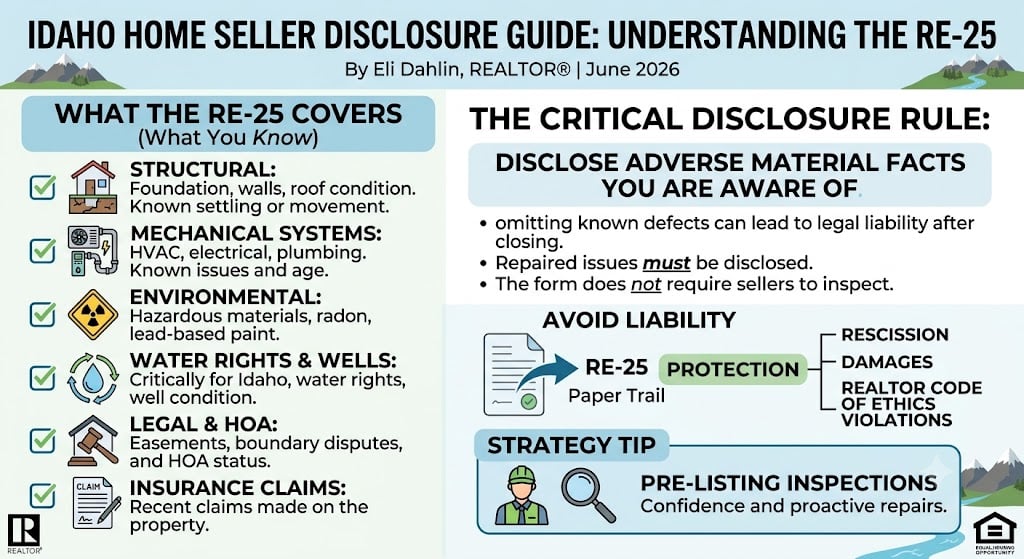
Idaho sellers are required to complete the RE-25 Property Condition Disclosure form, which covers known material defects related to the home's structure, mechanical systems, environmental conditions, legal status, and water access. Sellers must disclose adverse material facts they're aware of, and omitting known defects can lead to legal liability after closing. The RE-25 does not require sellers to inspect or investigate. It requires honest disclosure of what they already know.
By Eli Dahlin | June 7, 2026
One of the most anxiety-producing parts of selling a home for many people is the disclosure. What do I have to say? What if I'm not sure? What if I disclose something and it kills the deal?
Here's the honest answer: disclosure anxiety is usually worse than disclosure reality. Most buyers expect some history. What they don't expect, and what creates real legal problems, is finding something after closing that the seller knew about and didn't say.
In Idaho, the vehicle for all of this is the RE-25 Property Condition Disclosure.
What the RE-25 Covers
The RE-25 is the standard Idaho REALTORS® form that sellers complete to disclose known conditions about the property. It's not a home inspection. You're not required to investigate things you don't know about. It's a record of what you know.
The form covers:
-
Structural: Foundation, walls, roof, floors, any known settling, movement, or damage
-
Mechanical systems: HVAC, electrical, plumbing, known issues, repairs, age of systems
-
Environmental: Hazardous materials, underground storage tanks, lead paint (pre-1978 homes), radon
-
Water: Well condition, water quality, septic or sewer, and critically, water rights
-
Legal and HOA: Easements, encroachments, boundary disputes, HOA status and dues
-
Insurance claims: Any claims made on the property in recent years
-
Known defects you're aware of, even if repaired
For properties in Eastern Idaho with irrigation or agricultural water use, the water rights section deserves special attention. Idaho follows the prior appropriation doctrine, meaning water rights are tied to specific uses and seniority, administered through the Idaho Department of Water Resources. If water rights transfer with the sale, that's a material fact that needs to be accurately described. If they don't transfer, that needs to be clear too.
The Critical Rule: What You Know, You Must Disclose
Idaho law doesn't require you to hire inspectors or discover hidden problems before listing. The RE-25 obligation is specifically about adverse material facts you're already aware of.
That means:
-
You had a foundation crack five years ago that was repaired? Disclose it.
-
Your roof leaked two winters ago and you patched it? Disclose it.
-
There was a sewer line issue that the previous owner mentioned to you? Disclose it.
-
You've never noticed any problems in 15 years of living there? You answer accordingly.
The phrase sellers get into trouble with is "I didn't think it was a big deal." After closing, if a buyer discovers a defect you knew about and didn't disclose, "I didn't think it was material" is a difficult position to defend, especially when it's documented that you were aware of it.
What About Repairs?
A common misconception: if you fixed a problem, you don't have to disclose it. That's not how Idaho law works. A repaired problem is still a known material fact. Depending on the nature of the issue, buyers may want to know it happened, evaluate the quality of the repair, or decide it doesn't matter to them. Disclosing a repaired issue rarely kills deals. Buyers discovering an undisclosed issue after closing is what kills relationships, and sometimes leads to litigation.
What Happens if You Get It Wrong
Failing to disclose a known material defect can expose you to:
-
Rescission, where the buyer unwinds the sale and you have to take the house back
-
Damages, where the buyer sues for the cost of repair or diminution in value
-
REALTOR® code of ethics violations if your agent was involved in concealing the defect
Idaho does not require an attorney to handle real estate transactions. Closings go through title companies. But when disclosure disputes arise after closing, they often end up in court. The RE-25 is your paper trail that you disclosed what you knew. Fill it out honestly and completely.
Pre-Listing Inspections: A Strategy Worth Considering
One thing I often recommend for sellers in Idaho Falls who are uncertain about their home's condition: a pre-listing inspection. Hiring an inspector before you go to market gives you a complete picture of what exists, so you're not surprised by a buyer's inspector finding something you didn't know about.
It also gives you the option to repair items proactively, price the home accordingly, or disclose everything with confidence. A well-documented home with no surprises closes faster and with fewer renegotiations after inspection. That's worth the $400-$600 cost of an inspection in most cases.
Frequently Asked Questions
What is the RE-25 Property Condition Disclosure in Idaho?
The RE-25 is an Idaho REALTORS® standard form that Idaho home sellers use to disclose known material defects and conditions about their property. It covers the structural, mechanical, environmental, and legal status of the home, and is typically provided to buyers early in the transaction.
What happens if you don't disclose something on the RE-25 in Idaho?
Failing to disclose a known material defect in Idaho can expose a seller to legal liability, including rescission of the sale or a damages claim from the buyer. Idaho law requires sellers to disclose adverse material facts they know about, and "I didn't fill out the form" is not a legal defense.
Does the RE-25 cover water rights in Idaho?
Yes. For properties with water rights, the RE-25 addresses irrigation rights and water sources. Idaho follows the prior appropriation doctrine, meaning water rights are tied to specific uses and seniority, not just land ownership. Sellers should accurately disclose what water rights transfer with the property.
Do I have to disclose past foundation issues on the RE-25?
Yes, if you're aware of them. The RE-25 asks about structural issues, settling, and foundation problems. If you had foundation work done, even if repaired, that's a known material fact that should be disclosed. Failing to disclose known structural history is one of the most common sources of post-closing disputes in Idaho.
If you're preparing to sell in Idaho Falls or anywhere in Eastern Idaho and have questions about disclosure requirements or what to expect from the inspection process, I can walk you through it. Reach out at dahlinrealestate.com/contact and I'll send along my Seller's Guide with a pre-listing checklist.
About Eli Dahlin Eli Dahlin, REALTOR®, is a top 5% producing real estate agent with Silvercreek Realty Group, Idaho's largest independent brokerage. Serving Idaho Falls and Eastern Idaho, including Rigby, Shelley, Blackfoot, Pocatello, Rexburg, and Island Park, Eli has closed over 100 transactions and averages 20+ sales per year, with $20M projected 2026 production. He specializes in luxury homes, new construction, relocation, VA buyers, first-time buyers, and investment properties. Known for high-end marketing, strong negotiation, and modern video-driven listing strategies, Eli helps clients achieve exceptional results with a streamlined, professional experience.