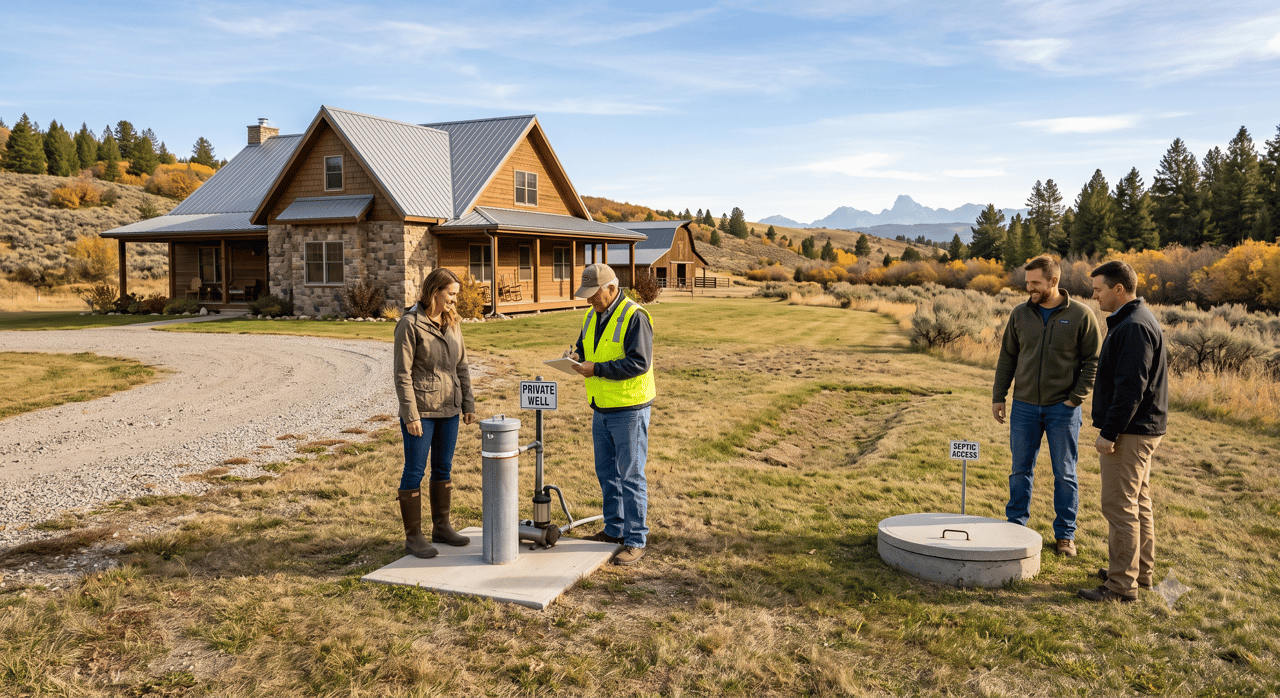
What do buyers need to know about purchasing a home with a well and septic in Eastern Idaho?
Homes with private wells and septic systems require additional due diligence beyond the standard home inspection. Buyers should have the well water tested for potability and review the well log for depth, output, and historical performance. The septic system should be inspected and pumped, with an assessment of its age, condition, and remaining useful life. These systems work well when properly maintained but can be expensive to repair or replace. Understanding what you're buying before closing protects you from significant unplanned costs after you own the property.
By Eli Dahlin | July 28, 2026
A significant portion of homes outside Idaho Falls city limits, in areas like Rigby, Shelley, Blackfoot, rural Bonneville County, and acreage properties throughout Eastern Idaho, rely on private wells for water and septic systems for wastewater. If you're buying one of these properties, there are specific inspection and testing steps that don't apply to homes on city water and sewer.
Here's what you need to know and what to ask for before you close.
Understanding Private Wells in Eastern Idaho
A private well is a drilling into the groundwater table that supplies the home's domestic water. Well performance varies significantly by location, depth, and the characteristics of the aquifer being accessed.
What to request and review:
The well log is a document submitted to the Idaho Department of Water Resources when the well was drilled, recording the depth, diameter, casing type, and water encountered at various depths. It also records the initial flow rate (gallons per minute). Most well logs in Idaho are on file with IDWR and can be accessed through their online database. Your agent or the seller should be able to provide this.
A well flow rate test measures current output, which may differ from the original drilling log if the aquifer has changed or if the pump or casing has degraded. For domestic use, a well producing 3-5 gallons per minute is generally adequate for a single-family home. Below that, storage tanks or other solutions may be needed.
Water quality testing is essential. Looking at a well and assuming the water is safe is not adequate. Eastern Idaho wells should be tested at minimum for:
- Coliform bacteria (indicator of contamination)
- Nitrates (from agricultural runoff, a significant concern in farming-heavy Eastern Idaho)
- Arsenic (naturally occurring in some Idaho geological formations)
- Hardness and pH (affects water quality and appliance longevity)
Your agent can coordinate a water test during the inspection period. Most labs in Eastern Idaho can turn around results within a few business days. If the test surfaces contamination, the seller may be able to address it (treatment systems, well rehabilitation), or it may be grounds for renegotiation or cancellation depending on your contract terms.
Consider the pump condition and age. Well pumps are submersible and can't be easily inspected visually. Ask about the pump's age and any recent service. A pump approaching end of life (typically 10-15 years for a submersible pump) is a cost to factor in.
Understanding Septic Systems in Eastern Idaho
A septic system treats household wastewater on-site, using a tank and a drain field (leach field) to process and disperse effluent. Properly maintained systems work reliably for decades. Neglected systems can fail, and replacement is expensive, often $8,000-$20,000+ depending on soil conditions, system type, and permitting requirements.
Request a septic inspection and pump-out. Before closing, have the septic system inspected by a licensed septic professional and pumped. The inspection should evaluate:
- Tank condition and whether it's functioning properly
- Inlet and outlet baffle condition
- Drain field condition and any signs of saturation or failure
- Whether the system has been properly maintained
Pumping the tank at inspection serves two purposes: it allows a complete visual inspection of the tank interior, and it starts your ownership with a clean slate.
Ask about the system's age and permitted capacity. Older systems may predate current code requirements. A system permitted for a three-bedroom home that's now serving a four-bedroom household may be undersized. Confirm that the system's permitted capacity matches the home's actual bedroom count.
Drain field location matters. Know where the drain field is located. You can't build over it, park vehicles on it, or plant trees near it without risking damage. This affects how you can use portions of the property.
Red flags to watch for. Soggy or lush green areas over the drain field (indicating surface saturation), sewage odors near the tank or field, slow drains throughout the house, and the presence of multiple distribution boxes or patches can indicate past or current system problems.
The Southeast District Health Department
For properties in much of Eastern Idaho, the Southeast District Health Department oversees septic system permitting and inspections. They can provide records of permitted systems, which is useful context for evaluating whether a system was properly installed and whether any modifications were permitted.
How to Structure Your Offer to Protect Yourself
When making an offer on a property with well and septic, make sure your inspection contingency explicitly covers these systems. Some standard inspection addenda need to specifically call out well testing and septic inspection, or you may lose the ability to negotiate based on those findings. Your agent should make sure the contract language is clear on this.
Frequently Asked Questions
Is well water safe to drink in Eastern Idaho?
Well water quality varies by location and can't be assumed safe without testing. Eastern Idaho wells should be tested at minimum for coliform bacteria, nitrates, and arsenic before you rely on the water. Testing during the inspection period is standard practice and recommended for any property with a private well.
How often should a septic system be pumped in Idaho?
Most septic professionals recommend pumping every 3-5 years for a typical household, though the right interval depends on household size, system capacity, and usage. A property where the previous owner hasn't pumped in many years is worth having inspected and pumped before closing so you start with a baseline understanding of the system's condition.
How much does it cost to replace a well pump in Idaho Falls?
Well pump replacement in Eastern Idaho typically costs $1,500-$4,000 depending on the pump size, depth, and accessibility. The pump itself is the primary variable cost. This is a manageable expense but worth knowing about if a pump is approaching end of life.
What happens if a septic system fails after I buy a home in Idaho?
If a septic system fails after closing and wasn't disclosed as a known issue, you may have legal recourse against the seller under Idaho's disclosure requirements if they knew about it. If it was an unknown latent defect, you're generally responsible as the new owner. This is why a pre-closing inspection and pump-out are so important, along with getting that inspection documented in writing.
If you're looking at properties with wells and septic systems in Rigby, Shelley, rural Bonneville County, or anywhere in Eastern Idaho, I can help you navigate the additional due diligence these properties require and connect you with qualified inspectors who specialize in these systems. Reach out at dahlinrealestate.com/contact and I'll send along my Buyer's Guide.
About Eli Dahlin Eli Dahlin, REALTOR®, is a top 5% producing real estate agent with Silvercreek Realty Group, Idaho's largest independent brokerage. Serving Idaho Falls and Eastern Idaho, including Rigby, Shelley, Blackfoot, Pocatello, Rexburg, and Island Park, Eli has closed over 100 transactions and averages 20+ sales per year, with $20M projected 2026 production. He specializes in luxury homes, new construction, relocation, VA buyers, first-time buyers, and investment properties. Known for high-end marketing, strong negotiation, and modern video-driven listing strategies, Eli helps clients achieve exceptional results with a streamlined, professional experience.