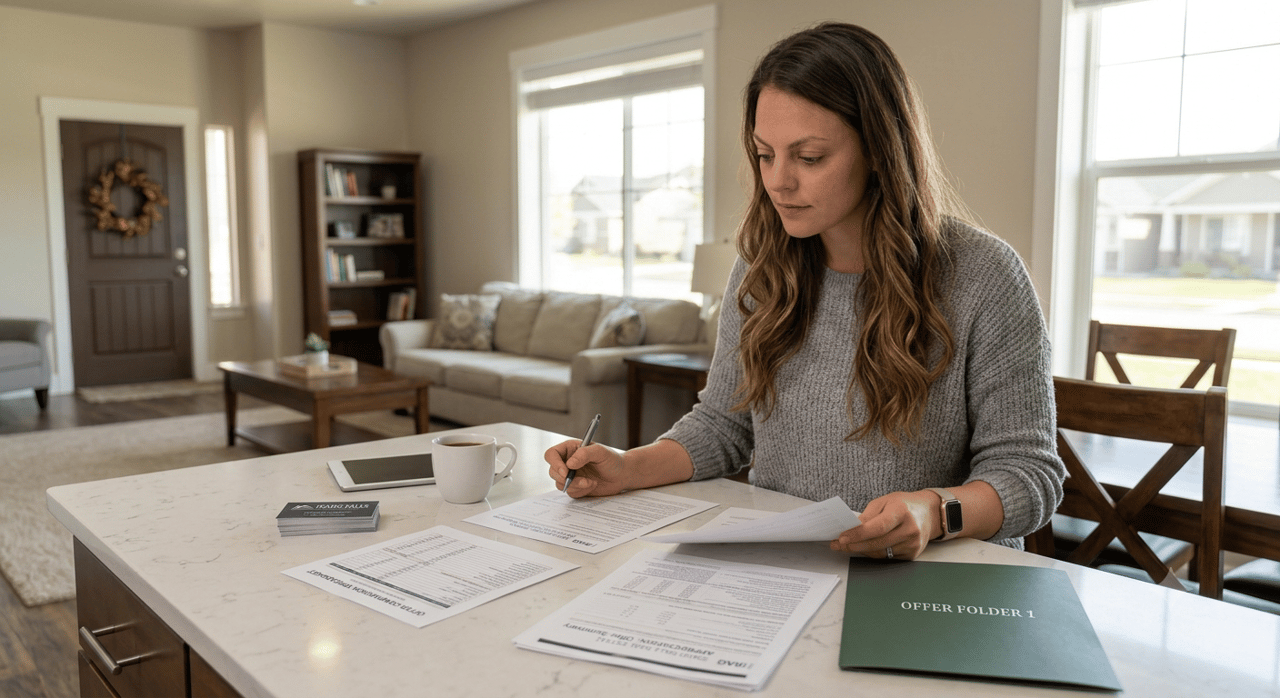
How should a seller choose between multiple offers?
The best offer is the one most likely to close at the best net, not simply the highest number. Compare each offer on five dimensions: net proceeds after concessions, financing strength (cash and conventional with large down payments carry less appraisal and underwriting risk), contingencies (especially Idaho's RE-52 home sale contingency, which ties your sale to another transaction), timeline fit, and earnest money. A $455,000 offer with an appraisal gap guarantee and 25 percent down frequently beats a $462,000 offer with thin reserves and a home to sell.
By Eli Dahlin | July 25, 2026
Multiple offers feel like winning the lottery, right up until you're staring at four contracts with different prices, different terms, and one weekend to decide. Choose wrong and you can spend the next 45 days watching the "best" offer fall apart while the backup buyers move on.
Well-priced homes in Park Taylor, Ivywood, and the newer subdivisions around the growth corridors still draw multiple offers in this market. Here's the exact framework I use with my sellers when it happens.
Price is the headline. Net and certainty are the story.
Two adjustments turn a stack of offers into an honest comparison:
First, compute the real net on each. A $460,000 offer asking for $8,000 in closing cost concessions and a home warranty nets less than a clean $454,000. Put every offer through the same net sheet before you compare anything else.
Second, discount for risk. An offer is a promise to attempt to close. The question is how likely each buyer is to actually get there, and at what price after the inspection and appraisal rounds. That's where the terms matter more than the number.
The five things I read before the price
Financing type and down payment. Cash closes fastest with no appraisal requirement. Conventional with 20 to 25 percent down has cushion if the appraisal lands soft. Low-down-payment loans can absolutely close, but a buyer with 3 percent down has no room to cover an appraisal gap, so their big number is only as strong as the appraisal. Look at the pre-approval letter too: a full underwritten pre-approval from a local lender beats an online pre-qualification every time, and I call every lender personally before we sign anything.
The RE-52 home sale contingency. This one is huge in Eastern Idaho right now, because a high volume of buyers have a home to sell first. An RE-52 offer means your closing depends on someone else's closing, a transaction you can't see or control. It doesn't make the offer worthless: an RE-52 buyer whose home is already under contract past inspection is a modest risk, while one whose home isn't even listed yet is a hope, not an offer. If you accept an RE-52, negotiate the bump clause terms so you can keep marketing and force a decision if a better buyer appears.
Appraisal terms. In a bid-up situation, the winning price may outrun the comps. An offer that includes appraisal gap coverage ("buyer covers up to $12,000 above appraised value") is materially stronger than the same price without it. If no offer includes gap language, that's a counter-offer opportunity.
Inspection posture. Shorter inspection periods and "right to terminate only" language reduce the odds of a second negotiation at day ten. I never advise buyers to fully waive inspections, and I'm wary when they do, because panicked concessions at the offer stage often turn into cold feet later.
Earnest money and timeline. Bigger earnest money signals commitment and raises the buyer's cost of walking. And the best offer fits your timeline: if you need three weeks after closing to move, a buyer offering a free rent-back may be worth more to you than $5,000 of price.
Your three moves as the seller
When the offers are in, you have three options with each buyer:
- Accept the strongest as written.
- Counter one buyer on specific terms. You can only formally counter one at a time in a way that binds you, so sequence matters.
- Call for highest and best from everyone, with a deadline. This is the standard play with three or more strong offers. You'll often gain price, gap coverage, and cleaner terms in the second round, but don't overplay it: buyers in 2026 have other options, and greed has blown up more multiple-offer situations than it has improved.
One more tool: accept a backup offer in second position. It costs you nothing, keeps pressure on your primary buyer through inspection, and gives you an instant plan B.
The mistake I see most
Sellers anchor on the biggest number and treat everything else as fine print. Then the appraisal lands $18,000 short, the 3-percent-down buyer can't bridge it, and six weeks later the home is back on the market carrying a fall-through in its history. The second showing of a home is never as strong as the first. Certainty has a dollar value. Price it in.
Frequently Asked Questions
Do I have to tell buyers there are multiple offers?
You choose the strategy with your agent. Disclosing "multiple offers received, highest and best by Sunday 5pm" typically drives stronger terms. Idaho agents must be honest in all representations, but you're not required to reveal the contents of competing offers.
Can I accept one offer and keep another as a backup?
Yes. A backup offer signed in secondary position automatically becomes primary if the first contract terminates. It's one of the most underused tools sellers have in this market.
What is an escalation clause and should I honor one?
An escalation clause automatically raises a buyer's price above competing offers up to a cap. They can work in your favor, but they come with verification obligations and sometimes appraisal risk at the escalated price. Have your agent walk through the specific language before relying on one.
Can I back out after accepting if a better offer shows up?
No. Once you've signed, you're under contract, and seller default has real legal consequences in Idaho. This is exactly why you compare carefully before signing rather than after.
Does the highest offer usually close at that price?
Not always. Between inspection negotiations and appraisals, aggressive offers often get trimmed before closing. This is why I weight financing strength and gap coverage so heavily in round one.
Multiple offers are only a win if you convert them into a closed sale at the best real net. That conversion is a strategy problem, and it's one of the places a listing agent earns their fee most visibly. If you're preparing to list in Idaho Falls or anywhere in Eastern Idaho, I'll show you exactly how I position homes to generate offer competition and how we'd evaluate the results. Reach out at dahlinrealestate.com/contact and I'll send you my Seller's Guide and top-dollar checklist.
About Eli Dahlin Eli Dahlin, REALTOR®, is a top 5% producing real estate agent with Silvercreek Realty Group, Idaho's largest independent brokerage. Serving Idaho Falls and Eastern Idaho, including Rigby, Shelley, Blackfoot, Pocatello, Rexburg, and Island Park, Eli has closed over 100 transactions and averages 20+ sales per year, with $20M projected 2026 production. He specializes in luxury homes, new construction, relocation, VA buyers, first-time buyers, and investment properties. Known for high-end marketing, strong negotiation, and modern video-driven listing strategies, Eli helps clients achieve exceptional results with a streamlined, professional experience.