Should an Idaho Falls seller accept a contingent offer?
Contingent offers, tied to the buyer selling their own home first, are common in Eastern Idaho right now, and sellers have a real decision to make. Whether to accept one depends on how competitive your listing is, how far along the buyer's home sale is, and whether you're using the RE-27 bump clause to protect your position. Accepting a contingent offer doesn't mean you're stuck, but you need the right paperwork in place.
By Eli Dahlin | June 4, 2026
If you've been on the market in Idaho Falls lately, you've probably seen it: an offer comes in, it looks solid on price, and then you get to the contingency section. The buyer needs to sell their home first.
Your first instinct might be to pass. But before you do, it's worth understanding what these offers actually mean in Eastern Idaho, how the process works, and when accepting one makes sense, and when it doesn't.
What the RE-52 Actually Does
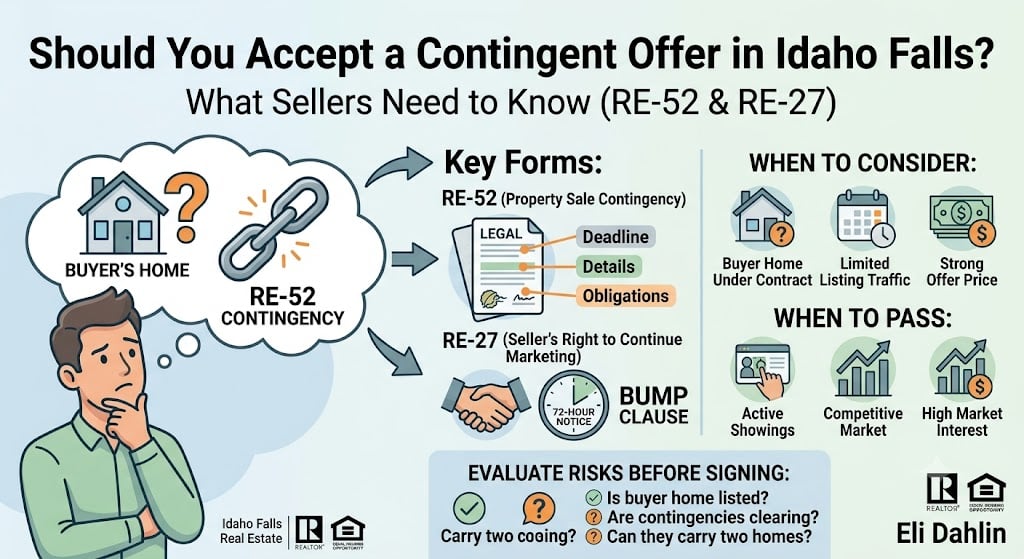
In Idaho, contingent offers that depend on a buyer selling their existing home use the RE-52 Property Sale Contingency form from Idaho REALTORS®. This form spells out:
-
Which property the buyer needs to sell
-
The deadline for them to sell it
-
Whether that property is already listed or under contract
-
What happens if the sale falls through
The key thing to understand: the RE-52 isn't just a gentleman's agreement. It's a binding part of the purchase contract. Once you sign it, you're in a legal agreement with real obligations on both sides.
Right now, I'm seeing a high volume of RE-52 contingencies across Bonneville and Bingham counties, particularly in the $350,000-$550,000 range. It reflects what's actually happening in the market: buyers who own homes want to move up or move sideways, but they haven't sold yet and can't carry two mortgages. They're not weak buyers. They're buyers who need to time things right.
Your Protection: The RE-27 Bump Clause
Here's the move most sellers should make if they accept a contingent offer: pair it with the RE-27 Seller's Right to Continue Marketing addendum.
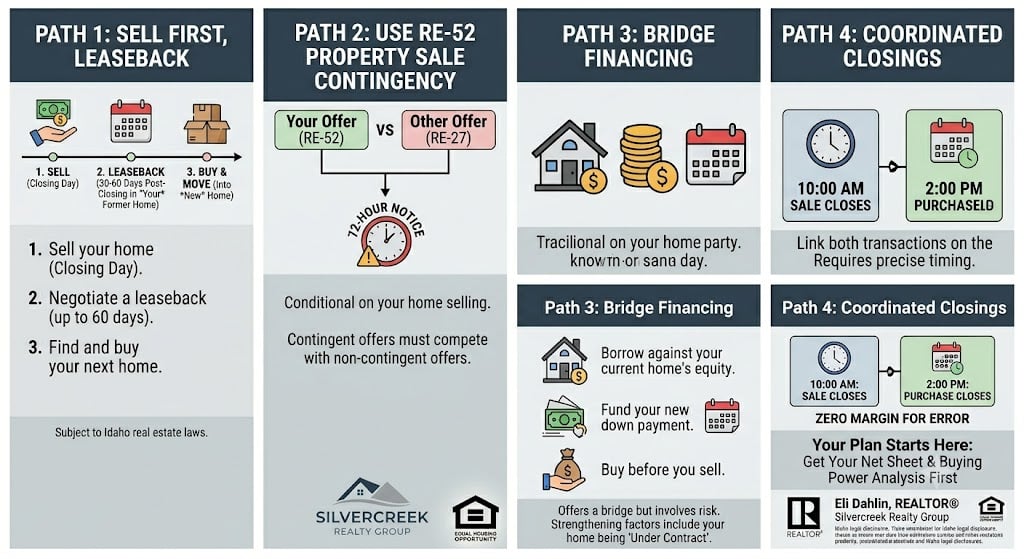
This form allows you to keep marketing your home even after you've accepted the RE-52 offer. If a second, non-contingent offer comes in, you can present it to your contingent buyer. They then have 72 hours (or whatever timeframe is written in the RE-27) to either:
-
Remove their contingency and proceed, which usually means committing to close even if their home hasn't sold yet
-
Walk away, in which case you move to the second offer
This is a meaningful protection. Without the RE-27, you're locked into the contingent contract and can't force the buyer's hand if a better offer materializes. With it, you're holding open the door.
One important note: make sure your agent properly fills in the specific number of hours in the RE-27. Idaho REALTORS® guidance is clear that writing "market" instead of an actual number creates ambiguity that can complicate everything if it gets disputed. Details matter in these forms.
When It Makes Sense to Accept
A contingent offer can be the right move in a few situations:
-
The buyer's home is already listed and actively under contract, meaning their contingency has a high probability of clearing
-
Your home is in a price range or location where buyer traffic is limited, and waiting for a non-contingent offer could cost you weeks of carrying costs
-
The offer price is strong enough that it justifies the uncertainty
-
You can pair it with the RE-27 and remain in control of your timeline
When to Pass
If you're seeing strong traffic, multiple showings in the first week, and your home is priced competitively in a segment where demand is active, holding out for a non-contingent offer is often the better play. In the Ivywood neighborhood or Cedar Estates in Shelley, for example, turnover is limited enough that qualified non-contingent buyers do appear when homes are priced and marketed well.
The scenario that hurts sellers most: accepting a contingent offer, letting market momentum pass, and then watching the buyer's home fall out of contract, leaving you with a stale listing.
The Right Way to Evaluate a Contingent Offer
Before you say yes or no to an RE-52 offer, ask your agent to investigate:
-
Is the buyer's current home listed? How long has it been on the market?
-
Is it under contract already? Has inspection been cleared?
-
Is the buyer pre-approved to carry both homes if their sale falls through?
-
What's the RE-52 deadline, and does it align with your timeline?
These questions change the risk profile of the offer significantly. A buyer whose home has been on the market for 60 days in a different state is a very different situation from a buyer whose Rigby home went under contract last week and clears inspection in three days.
This is exactly the kind of analysis I walk through with every seller I represent. Every contingency is different, and the right answer depends on what you can find out about the buyer's specific situation, not just the form they checked on the contract.
Frequently Asked Questions
What is the RE-52 Property Sale Contingency in Idaho?
The RE-52 is an Idaho REALTORS® form that makes a purchase offer contingent on the buyer selling their existing home first. It specifies the property the buyer needs to sell, the deadline, and the terms under which either party can cancel if the sale doesn't happen in time.
What is the RE-27 bump clause in Idaho real estate?
The RE-27 is a Seller's Right to Continue Marketing addendum that allows a seller to keep marketing their home after accepting a contingent offer. If a better offer comes in, the seller can notify the original buyer, who then has 72 hours (or the time specified in the RE-27) to remove their contingency or lose the contract.
Should I accept a contingent offer on my Idaho Falls home?
It depends on your market position, timeline, and the strength of the buyer's existing home sale. If you're in a slower price range with limited buyer activity, a contingent offer with an RE-27 bump clause can be a smart move. If you have strong market interest, you may want to hold for a non-contingent offer.
Can a seller back out of a contingent sale contract in Idaho?
Not without consequences. Once you've accepted an offer, even a contingent one, you're in a binding contract. You can use the RE-27 to keep marketing and force the buyer to remove contingencies, but you cannot simply cancel without legal risk. Consult your agent and review the contract terms carefully before taking any action.
Navigating contingent offers is one of the trickier parts of selling in Eastern Idaho's current market. If you're weighing an offer and want a second opinion on how to structure it, or whether to accept at all, reach out at dahlinrealestate.com/contact and I'll send along my Seller's Guide as well.
About Eli Dahlin Eli Dahlin, REALTOR®, is a top 5% producing real estate agent with Silvercreek Realty Group, Idaho's largest independent brokerage. Serving Idaho Falls and Eastern Idaho, including Rigby, Shelley, Blackfoot, Pocatello, Rexburg, and Island Park, Eli has closed over 100 transactions and averages 20+ sales per year, with $20M projected 2026 production. He specializes in luxury homes, new construction, relocation, VA buyers, first-time buyers, and investment properties. Known for high-end marketing, strong negotiation, and modern video-driven listing strategies, Eli helps clients achieve exceptional results with a streamlined, professional experience.